
Adding pieces
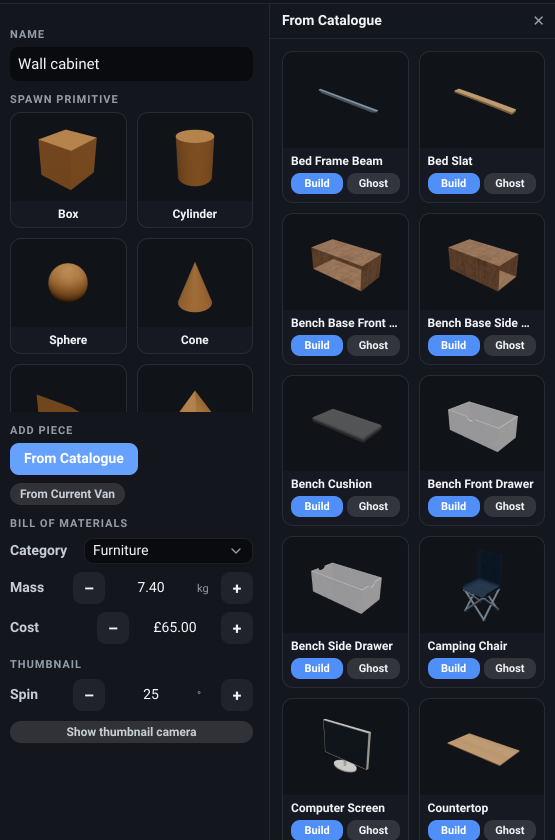
A custom object is a stack of pieces. There are three ways to add one, all in the left-hand panel: spawn a basic solid, bring in a catalogue component, or bring in another object from this design. A fourth thing you can add is not a piece at all - a reference ghost, which is a see-through guide you position work against and which never becomes part of the object.
A new object starts empty, so the first thing you do in here is add a piece.
Whatever you add lands beside what is already there rather than on top of it: its centre is put 400 mm past the far edge of everything already in the scene, along X (the red axis). A default-sized solid therefore lands with a comfortable gap; something much larger lands closer in, but still to the side. It arrives selected and joins the stack as Add, so you can move it into place immediately.
Add a shape
Section titled “Add a shape”What it is. The grid of thumbnail cards under Spawn primitive. It scrolls, so the rest of the panel stays reachable.
What it does. Clicking a card drops that solid into your object.
Options and limits. There are eight: Box, Cylinder, Sphere, Cone, Wedge, Pyramid, Dome (a half sphere) and Torus (a ring). Each arrives at a sensible default size - between 120 and 500 mm on a side - and every one of them can then be resized on all three axes independently, so a cylinder can become an oval column and a sphere an egg.
Only some of them can have their edges rounded or chamfered: box, cylinder, cone and dome. See Shaping a piece.
What it affects. Adds one piece. Undoable.
From catalogue
Section titled “From catalogue”What it is. The first of the two Add piece buttons. It stays lit while its picker is open, and pressing it again closes it.
What it does. Opens a picker of the built-in catalogue, so you can use a real component as a building block - subtract a fridge to leave the recess it will sit in, or add a worktop to a frame you have built.
Options and limits. Every component you can place in the van is offered, and it comes in with its real shape rather than as a stand-in box. Because every built-in component is itself built from solids, a Build always arrives as a group named after the component - expand it in the build list and you can reach the individual solids it is made of. A pre-made kit, a bench with a drawer say, arrives the same way, as a group of its parts. That grouping is for building with: it is not kept when the object is saved, as the build list explains.
What it affects. Nothing until you pick a card.
From this design
Section titled “From this design”What it is. The second Add piece button, labelled From Current Van.
What it does. Opens a picker of the other custom objects in the design you are working on, so an object you have already built can be a component of a bigger one.
Options and limits. It is greyed out when there are none, and it never offers the object you are currently editing. What it brings in is a copy taken at that moment - not a link - so improving the source object afterwards leaves this one as it was.
What it affects. Nothing until you pick a card.
What it is. The ✕ at the top-right of the picker panel.
What it does. Closes the picker.
Options and limits. Pressing the From Catalogue or From Current Van button again closes it too. On a normal window the picker floats over the left edge of the 3D view rather than pushing it aside, so opening and closing it never resizes the canvas or moves your camera; on a narrow window the same cards appear inline under the buttons instead, and there is no ✕.
What it affects. Nothing.
Add a piece
Section titled “Add a piece”What it is. The cards inside either picker: a thumbnail, the component’s name, and two buttons.
What it does. Build brings the component into your object as real geometry you can combine, move and turn. Ghost adds it as a see-through reference instead - visible, positionable, and not part of the finished object.
Options and limits. Build and Ghost land the thing in exactly the same place, so you can ghost something to try it, then build it once you are happy. A Build arrives as a group named after the source, whichever picker it came from; a Ghost of a kit arrives as one ghost per part, and a ghost of anything else as a single ghost.
What it affects. Adds a piece or a ghost. Undoable.
Reference ghost
Section titled “Reference ghost”What it is. A row under Reference ghosts at the foot of the build list, marked with a ◇. The section only appears once you have at least one.
What it does. A ghost is a guide. It is drawn translucent in the scene, it can be selected, moved and rotated like anything else, and it is not part of the object you are building - it contributes no shape, no weight and no cost, and it is not drawn when the object is placed in the van.
Options and limits. Ghosts stay visible while Result is on, deliberately, so you can check the fused shape against the thing you were lining it up with - and they stay live with it, so a ghost can still be selected and moved while the fused object is on screen. They cannot be resized, they cannot be grouped, and they have no combine mode - there is nothing for them to combine with.
They are saved with the object, so re-opening it for editing brings your guides back exactly where you left them.
The ✕ at the end of the row removes the ghost. Selecting a ghost and pressing Delete does the same.
What it affects. What you see while building. Nothing in the finished object.
Related
Section titled “Related”- Shaping a piece - moving and sizing what you have added.
- The build list - the stack, and how each piece combines.
- The catalogue - the components the picker offers.