
The build list
Build pieces is the lower half of the right-hand panel, and it is the object’s recipe. The order matters: the first piece is the base, and every piece below it is applied to the running result of everything above it. So a Subtract works on what is above it in the list and is untouched by what is below.
That is why the same three shapes can give different objects depending on the order they are stacked in, and why moving a row up or down can change the result rather than just tidying the list.
Above the rows sit the two selection chips and the Group / Ungroup buttons.
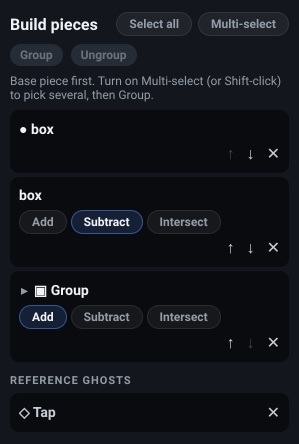
Build piece
Section titled “Build piece”What it is. One row per piece, in stack order. The first top-level row is marked with a ● - that is the base. A group row shows ▣ and the group’s name; a solid shows its shape.
What it does. Clicking the row selects that piece, exactly as clicking it in the 3D view does, and the transform controls above jump to it.
Options and limits. The row carries the piece’s own controls: its combine chips, the reorder arrows and the remove button. Shift-clicking a row toggles it in or out of the selection instead of replacing it, so a second Shift-click on the same row takes it back out again.
A group’s members are not shown until you expand it. Selecting a member from an expanded group opens that group up in the scene so the member can be edited on its own.
What it affects. What is selected.
Combine mode
Section titled “Combine mode”What it is. The Add / Subtract / Intersect chips on a row.
What it does. Sets what this piece does to everything above it in the list. Add joins it on, Subtract carves its volume away, Intersect keeps only the part where the two overlap.
Options and limits. The base piece has no chips - there is nothing above it to combine with, so its mode would mean nothing. The same is true of the first member inside a group.
The 3D view colour-codes the choice while you are editing, which is the quickest way to read a stack: Add is drawn solid, Subtract translucent red and Intersect translucent green. Switch on Result to see what they actually produce.
A subtractor has to overlap something to do anything, and it is normal for it to stick out well beyond the object - a cylinder used to bore a hole should be longer than the thing it goes through.
What it affects. The shape of the finished object.
Reorder
Section titled “Reorder”What it is. The ↑ and ↓ buttons at the end of a row. They are greyed at the ends of the list.
What it does. Swaps the piece with its neighbour, moving it up or down the stack.
Options and limits. Only top-level pieces can be reordered; a member inside a group has no arrows.
Moving a piece into or out of the first slot changes what gets built, because the first piece is the base and its own combine mode is ignored - drag a Subtract to the top and it stops subtracting. Its mode is remembered, though, so moving it back restores what you had.
What it affects. The order pieces combine in, and so the shape of the object.
Remove piece
Section titled “Remove piece”What it is. The ✕ at the end of a row.
What it does. Deletes that piece from the object. On a group row it deletes the group and everything in it.
Options and limits. There is no confirmation, but it is undoable. The same ✕ on a reference ghost row removes the ghost, and pressing Delete with something selected does the same.
The list is allowed to go completely empty - the editor does not stop you - at which point Save greys out until you add a piece again.
What it affects. Removes the piece. Undoable.
Expand group
Section titled “Expand group”What it is. The ▸ / ▾ chevron at the start of a group row.
What it does. Shows or hides the group’s members, indented under it.
Options and limits. It works at any depth, so a group inside a group opens the same way. An expanded member row behaves like any other: it can be selected, its combine mode set, and it can be removed. What it cannot do is reorder - those arrows are top-level only.
What it affects. What the list shows. Nothing in the object.
Select all
Section titled “Select all”What it is. The first chip beside the Build pieces heading.
What it does. Selects every top-level piece and every reference ghost at once.
Options and limits. It is greyed out only when there is nothing at all to select. It selects groups as wholes rather than reaching inside them, which is what you want for the two things it is for: moving the whole build together, and setting one colour or texture across everything in it.
What it affects. What is selected.
Multi-select
Section titled “Multi-select”What it is. The second chip. It stays lit while it is on.
What it does. Makes every click add to or remove from the selection instead of replacing it, so you can gather several pieces without holding a key.
Options and limits. Shift-clicking does the same thing one click at a time and needs no toggle; the chip exists so that the same job works with a trackpad or a touchscreen. It stays on until you turn it off.
One useful difference: with it on, clicking empty space leaves your selection alone, where an ordinary click there would clear it.
What it affects. How clicks are interpreted.
What it is. The Group button under the chips.
What it does. Wraps the selected pieces into a single group that moves and turns as one and shows as one row in the list.
Options and limits. It needs two or more things selected, and every one of them must be a top-level piece - so a selection that includes a reference ghost, or a member you drilled into inside another group, leaves the button greyed.
Two things about the result are worth knowing before you press it. The group is dropped into the first selected piece’s slot, with its members in the order they were in - so grouping pieces that were not adjacent moves them together and changes the fold order, which can change the shape. And the first member’s combine mode is reset to Add, with the group as a whole joining as Add - so a piece that used to carve something outside the group stops doing so. Both are the ordinary consequence of “treat these as one thing”, and Undo takes them back.
A group you make is called Group; one that arrived from a picker keeps the name of what it came from, for as long as the editor stays open. There is no rename in here - a group is scaffolding for building, not something the finished object carries, and that is literally true of what gets saved. Save an object and re-open it for editing and every group comes back as a plain Group; a group that was the first piece in the list comes back as loose pieces rather than as a group at all. The shape is identical either way - it is the grouping that is not kept, not the geometry.
What it affects. The structure of the object, and possibly its shape. Undoable.
Ungroup
Section titled “Ungroup”What it is. The Ungroup button beside Group.
What it does. Dissolves the selected group, putting its members back into the stack where the group was.
Options and limits. It needs exactly one top-level group selected. The members keep their positions and their combine modes, except the first, which takes the group’s mode. Nothing is left selected afterwards.
It is also the answer when a nested group is in your way: ungroup the outer one to bring the inner pieces up to the top level, where they can be reordered and moved as one again.
What it affects. The structure of the object. Undoable.
Related
Section titled “Related”- Adding pieces - where the rows in this list come from.
- Shaping a piece - the controls for whatever you select here.
- The editor toolbar - Result, for checking what the stack builds.