
Camera and navigation
Getting the camera where you want it is most of the work of designing in 3D. VanCAD gives you two ways to move it, two ways to project it, and one button that puts it back.
Orbit / Fly
Section titled “Orbit / Fly”What it is. A single toolbar button that names the mode you are in and switches to the other when pressed: Orbit to circle a fixed point, Fly to stand inside the van and look around.
What it does.
- In Orbit, dragging turns the camera around a point in the middle of the van, as though the van
were on a turntable. Right-dragging slides that point (a pan), and the scroll wheel moves in and
out. This is the mode for arranging a layout.
- On a laptop trackpad, a two-finger scroll slides the view and a pinch zooms - the gestures you would expect from any other drawing or map app. VanCAD works out which device sent the gesture, so a mouse wheel still zooms as it always has. To slide the view freely in both directions at once, use a two-finger click and drag: that is the trackpad’s right-drag, and it is the same pan, unrestricted (see below for why the scroll is not).
- In Fly, the camera stays put and dragging turns your head instead. Right-dragging slides you sideways and up or down, and the scroll wheel walks you forwards and backwards along the direction you are looking. This is the mode for judging whether the space feels right from inside it.
Options and limits. A two-finger scroll pans along one axis at a time: start it moving straight up and it keeps to the vertical until you lift your fingers and start again, and the same sideways. That is your browser, not VanCAD - Chrome and Safari commit a trackpad scroll to whichever direction it began in (they call it railing) and report the other direction as zero movement, so the page is never told about it. Every canvas app on the web behaves this way. Starting the scroll diagonally avoids the lock, and a two-finger click and drag is never railed at all, so that is the gesture to reach for when you want to move the view in both directions in one go.
Fly is always drawn in perspective - walking forwards has no meaning in an orthographic projection - so the projection toggle has no visible effect until you switch back to Orbit. In either mode, dragging one of an object’s coloured handles moves the object, not the camera; the camera stands aside for the drag and picks up again afterwards. Switching modes never jumps the view: Fly starts looking at exactly what Orbit was showing. While Fly is on, a notice in the top-right corner of the 3D view says so and carries the way out (see below).
What it affects. Nothing in your design. Where the camera is is not saved, and it is not an undoable edit.
Exit Fly Mode
Section titled “Exit Fly Mode”What it is. A small notice that appears in the top-right corner of the 3D view for as long as Fly is on, naming the mode, listing its three controls, and carrying a button that leaves it.
What it does. Pressing Exit Fly Mode puts you back in Orbit, exactly as pressing the toolbar button again would. The notice then disappears, and it comes back the next time Fly is turned on.
Options and limits. The notice is not dismissible on its own: while it is on screen you are in Fly mode, so it is a readout of the state rather than a message to close. It sits over the 3D view and does not block it - the design behind it still turns and selects normally.
What it affects. Nothing in your design, and nothing that is saved.
Perspective / Orthographic
Section titled “Perspective / Orthographic”What it is. A single toolbar button labelled Persp or Ortho for the projection in use,
switching to the other when pressed. On a phone or tablet layout it is a two-option control in the
options (...) menu instead.
What it does. Perspective draws the van the way an eye or a camera sees it: things further away are smaller, and lines that are parallel in reality converge on the screen. It reads as realistic, and it is the better mode for judging how a space feels. Orthographic removes that convergence - parallel lines stay parallel and an object is drawn the same size wherever it sits - which is what CAD elevations do, and what makes it the better mode for lining things up and comparing sizes by eye.
Options and limits. The switch preserves your viewpoint: the camera keeps its position, its target and its apparent scale, so the van does not jump or resize as you toggle. While Fly is active the projection is forced to perspective (see above).
What it affects. Only how the scene is drawn.
Navigation cube and Home
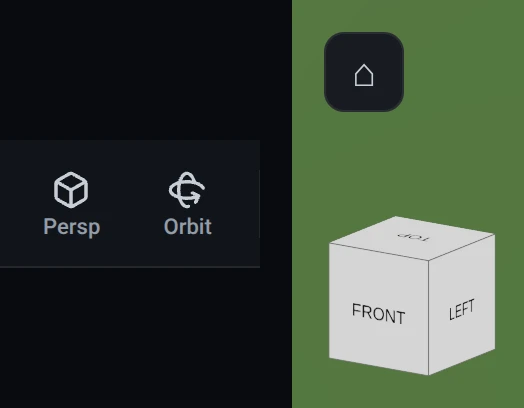
Section titled “Navigation cube and Home”What it is. Two controls in the bottom-right corner of the 3D view: a small orientation cube
that mirrors the camera’s current heading, and a Home button (⌂) just above it.
What it does. Clicking a face of the cube snaps the camera to that straight-on view - Front is the cab end, Back the rear doors, and Top looks straight down into the van. Clicking an edge or a corner snaps to a halfway or three-quarter view, which is how you get a clean isometric-style angle in one click. Home returns the camera to the view the design opened at: its position, what it is pointed at, and how far it is zoomed.
Options and limits. The cube changes orientation only - it does not re-centre or re-zoom, which is what Home is for. Both are desktop controls; the mobile viewer has its own view pad in the same corner. The cube is hidden in Fly mode, where you steer the camera directly and snapping to a standard orbit view has nothing to pivot around. It is hidden while you are drawing an opening too: there the camera is locked square to the surface you are cutting, and Home changes job to match, re-centring on that surface rather than throwing you out of the drawing view.
What it affects. Nothing in your design.
Related
Section titled “Related”- The Visuals settings - auto-rotate, ground and sky, and the guide lines shown while you drag.
- Selecting, moving and resizing - the on-object handles the camera stands aside for.
- Tutorial: Quick User Interface Guide, in the app under Tutorials.